

Onassis Cardiac Surgery Center Success Story: Consulting services for leveraging medical data using Clinical Decision Support Systems (CDSS)
We are happy to present the successful collaboration between Onassis Cardiac Surgery Center and smartHEALTH.
Key Information
Since 1993, when it began operating thanks to a donation from the Onassis Foundation, the Onassis Cardiac Surgery Center (OCSC) has been a benchmark for cardiology and cardiac surgery in Greece. Having contributed decisively to reshaping the country’s cardiology landscape, it continues to set the standards for medical excellence to this day.
The OCSC is the largest specialized cardiology and cardiac surgery center in Southeast Europe, and the first hospital in Greece certified for the development and provision of healthcare services in these fields. Through a recent donation from the Onassis Foundation, its facilities have been fully upgraded with state-of-the-art, environmentally friendly infrastructure that not only serves the needs of patients but also fosters a functional and supportive environment for the medical and nursing staff.
- Technologies Used: Kyklos CDSS
- Collaboration Period: September 2023 – December 2025
- Services Provided: Consulting services for leveraging medical data using Clinical Decision Support Systems (CDSS)
The Challenge
The Onassis Cardiac Surgery Center is the first hospital organization in Greece to have completed the transition to a fully electronic hospital. At the same time, the establishment of the transplant department in recent years has brought about significant changes to the existing data ecosystem, leading to a rapid increase and accumulation of large volumes of heterogeneous information. Despite the digital transformation, the exploitation of these data remains limited, as a substantial portion is unstructured (e.g., free-text medical reports), making their effective retrieval and processing by medical staff particularly challenging—especially in cases requiring the rapid identification of critical clinical events.
During the assessment of the organization’s digital maturity, the need for advanced clinical decision support tools became evident—tools capable of managing and efficiently leveraging the growing volume and complexity of data. Within this context, the activities of the smartHEALTH hub contributed to the exploration and design of a new Clinical Decision Support System (CDSS) philosophy, tailored to the hospital’s information system.
The proposed CDSS aims to provide personalized support for patients’ therapeutic plans, in accordance with the applicable clinical guidelines and circulars of the respective healthcare system. In parallel, it was designed with an architecture that enables scalability and the integration of multiple data types (e.g., images, text) through plug-in–based mechanisms, facilitating both the holistic utilization of available information and the faster retrieval of clinically relevant knowledge by healthcare professionals.
The Solution
The proposed solution included the development of the Kyklos Clinical Decision Support System (CDSS), along with an accompanying tool for the annotation and structured representation of medical guidelines. The solution was designed as an integrated platform for leveraging the entirety of available patient information, with the aim of supporting medical staff throughout the clinical decision-making process.
The Kyklos system combines patients’ clinical data with the official medical guidelines of the respective healthcare system, providing healthcare professionals with evidence-based recommendations regarding the appropriate next steps in the therapeutic process. At the same time, it enables the comparative evaluation of clinical decisions against the established guidelines, enhancing transparency and facilitating the understanding of deviations, without substituting the physician’s scientific judgment.
At an initial stage, the implementation of the solution was carried out without the use of artificial intelligence, leveraging a specialized, internally developed data architecture of the Athena Research Center. This approach ensured reliability, explainability, and full control over the system’s operation. At a later stage, the integration of artificial intelligence techniques is envisaged, with the aim of optimizing the search and retrieval of clinical events within patients’ medical histories, while maintaining the system’s strictly supportive role and without influencing or replacing the clinical judgment of healthcare professionals.
The Implementation
The implementation methodology of the proposed solution was based on a structured and iterative collaborative process between the Athena Research Center and the Onassis Cardiac Surgery Center. The development and shaping of the product were carried out primarily in-house by the ATHENA research team, with continuous feedback from the recipient organization.
Within the framework of the collaboration, a total of five (5) organized meetings were held with the Onassis team. The main objectives of these meetings were: (a) the presentation and evaluation of project progress, (b) the exploration and joint formulation of alternative directions and functional requirements, and (c) the exchange of critical information regarding the organization’s information systems, processes, and operational needs.
Taking into account the high level of digital maturity of the Onassis Cardiac Surgery Center, as well as the fact that the organization maintains fully electronic storage of medical data and supports interoperability through the HL7 standard, the development of the prototype was based on standardized HL7-type data input. In parallel, for the initial implementation and testing of the system, the NICE clinical guidelines of the United Kingdom in the field of cardiology were selected, as they constitute a widely recognized and relatively easily processable set of medical guidelines.
The main development phase of the prototype took place during the period March–November 2025. During the initial phases of the collaboration, challenges were identified that were related to organizational needs already addressed in terms of information organization and management. As a result, the methodology was adapted and the collaboration was refocused, with a primary emphasis on maximizing the exploitation of the existing wealth of data and on supporting clinical decision-making.
The Benefits
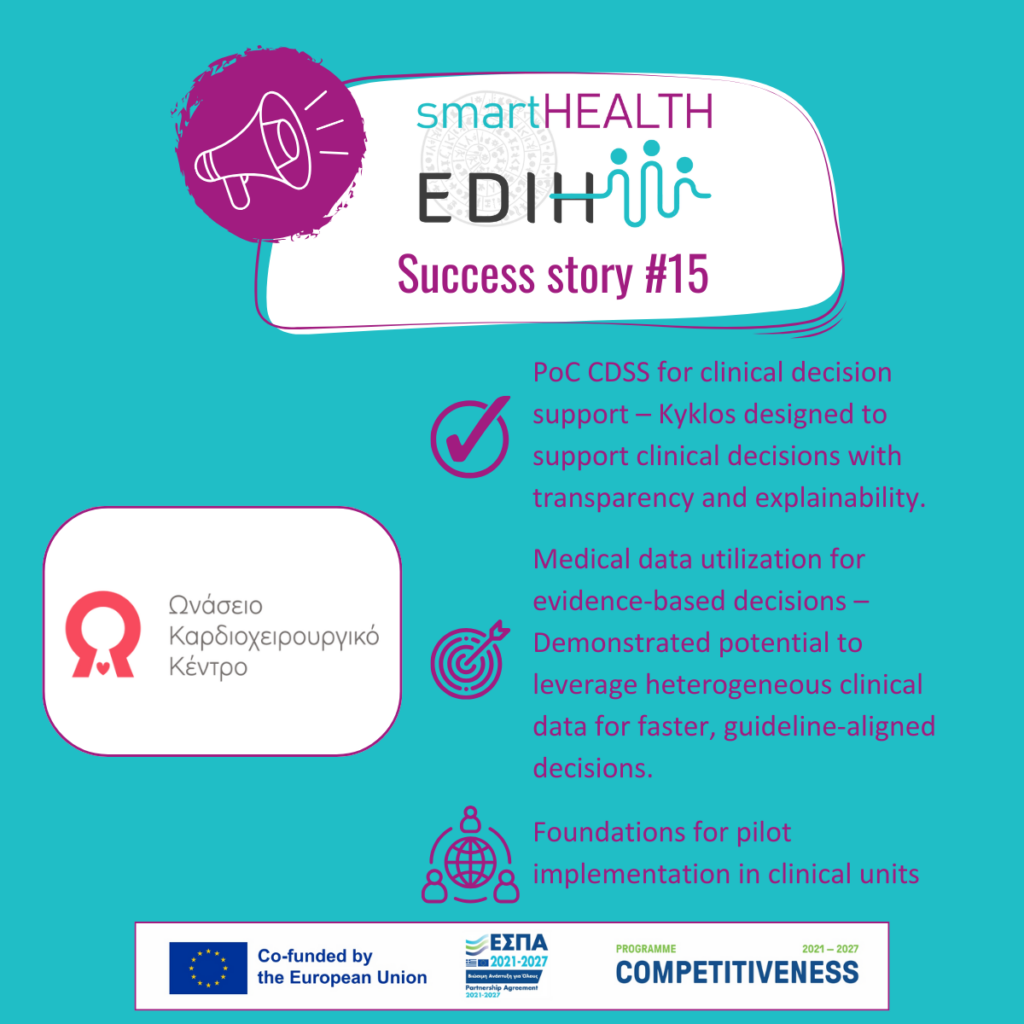
The collaboration between the Athena Research Center and the Onassis Cardiac Surgery Center, within the framework of their participation in the smartHEALTH hub, led to the development and presentation of a proof-of-concept (PoC) Clinical Decision Support System (CDSS), with the aim of exploring the practical applicability of such a solution within a fully digitized clinical organization.
Through the PoC, it was possible to articulate the architecture and functional philosophy of a CDSS designed for direct and reliable use in medical practice, with a particular emphasis on transparency, explainability, and control over the proposed outputs. The decision to develop a product without the use of artificial intelligence mechanisms allowed for the avoidance of bias in clinical decision-making, ensuring that the system operates in a strictly supportive manner and does not replace the scientific judgment of medical staff.
For the Onassis Cardiac Surgery Center, the primary benefit of participation in the smartHEALTH hub was the opportunity to assess, within an experimental and controlled environment, the capabilities of such a system in terms of organizing, correlating, and leveraging existing medical information. During the final presentations and evaluation discussions of the PoC, the organization acknowledged the potential operational facilitation that a future production-level implementation of the system could provide.
Furthermore, strong interest was expressed in exploring further collaboration, with the aim of potentially adapting and piloting the solution within specific clinical units, such as the transplant department, which was identified as one of the most suitable application areas offering high added value.
Lessons Learned
The development of Clinical Decision Support Systems (CDSS) constitutes a rapidly evolving and highly demanding technological domain, in which access to realistic data for testing and evaluation remains limited. Collaboration with a mature and fully digitized hospital organization, such as the Onassis Cardiac Surgery Center, proved to be a decisive success factor, as it enabled an in-depth understanding of the structure, interoperability, and characteristics of the available clinical data—even without direct access to their actual content. This knowledge proved critical for the realistic design and development of a CDSS tailored to the real-world operational conditions of a hospital.
A key element that facilitated the collaboration was the continuous and direct communication with representatives of the recipient organization, as well as the provision of advisory guidance on the part of the hospital. The active involvement of the recipient from the early stages contributed to the alignment of expectations and the timely identification of constraints and alternative directions.
Conversely, a major challenge was the limited access to medical data with real content, which made it necessary to initiate legal and regulatory compliance procedures at an early stage. The experience highlighted the importance of promptly drafting and finalizing Data Processing Agreements (DPAs), in order to avoid delays in the commencement of development activities.
As a core recommendation to other service providers and recipients, early investment in clear communication mechanisms, legal preparedness, and a shared understanding of operational constraints is strongly advised. Beyond the jointly defined action plan, the primary benefit for both parties was the mutual transfer of expertise, the expansion of collaborative networks, and direct exposure to the real needs and conditions of the healthcare market.











