
Target Analysis Success Story: Provision of Consulting Services for the Design, Optimization, and Interoperability of Omics Pipelines
This report presents a successful collaboration story between Target Analysis, a company specialized in mass spectrometry analyses and the development of omics solutions, and the European Digital Innovation Hub smartHEALTH.
Key Information
Target Analysis was founded in 2013 by a team of experienced scientists and engineers. The company activates in the distribution and service of scientific instruments for analytical techniques in Greece.
- Technologies Used: High-Resolution Mass Spectrometry (HRMS), FAIR Data Management principles, cloud-based infrastructures, open data standards (mzML, JSON, CSV), APIs and workflow automation techniques
- Collaboration Period: February 2025 – December 2025
- Services Provided: Consulting Services for the Design, Optimization, and Interoperability of Omics Pipelines
The Challenge
Target Analysis, a company specialized in mass spectrometry analyses and the development of omics solutions, wanted to upgrade its technical capabilities to support multivariate analyses (proteomics, metabolomics, lipidomics) and to align with international data management standards. During the assessment of its digital maturity, needs were identified related to:
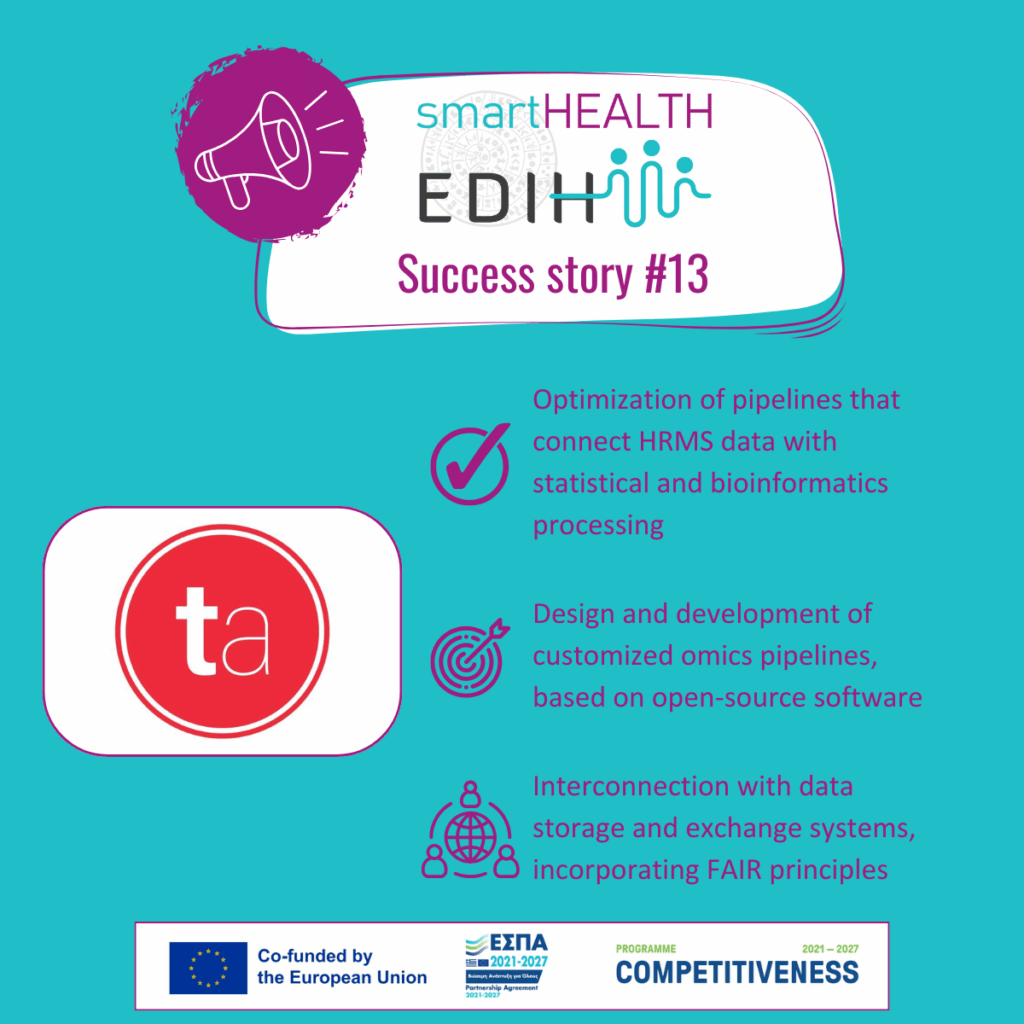
- the optimization of pipelines that connect HRMS data with statistical and bioinformatics processing,
- ensuring the reproducibility and interoperability of analyses,
- data management and exchange with modern storage and analysis systems,
- and the utilization of open-source technologies to reduce costs and increase flexibility.
The collaboration with the NKUA’s Laboratory of Analytical Chemistry, aimed to develop a technical framework that would unify the above, i.e. from the design of HRMS pipelines to the creation of a secure and reusable data infrastructure.
The Solutions
The project team developed, in collaboration with Target Analysis, a three-fold technical action plan that included:
- Assessment and technical description of HRMS infrastructures, aiming to optimize settings, workflows and data quality control.
- Design and development of customized omics pipelines, based on open-source software, with automation of stages such as pre-processing, normalization, statistical modeling and pathway analysis.
- Interconnection with data storage and exchange systems, incorporating FAIR principles (Findable, Accessible, Interoperable, Reusable), secure APIs and file standards (mzΧML, CSV, JSON).
The solution focused on increasing technical efficiency, reducing analysis time and establishing a unified data policy. At the same time, a framework for continuous upgrading of pipelines was created, so that they can adapt to new experiments, technologies and clinical data.
The Implementation
The collaboration was implemented through four (4) two-hour online meetings during Phase I and seven (7) two-hour online meetings during Phase II, between the project team from the Laboratory of Analytical Chemistry and Target Analysis’ executives.
During the first four meetings of Phase I, the company and its digital technologies were presented, digital maturity was assessed, a detailed action plan was developed and discussed. During the first four meetings of Phase II, a needs analysis was carried out, mapping of existing processes and collection of technical specifications were carried out. In the following sessions, pilot pipelines were designed and presented, with application to test datasets, which were evaluated in terms of accuracy, sensitivity and processing speed. The final phase focused on the integration with data storage and exchange systems, with the aim of creating a unified management infrastructure that allows secure access, visualization and feedback. The final report included detailed technical recommendations, proof-of-concept workflows and automation proposals, which were discussed and approved by the company team.
The Benefits
The collaboration led to a significant upgrade of Target Analysis’ research and technical infrastructure. In more detail, the following were done:
- Standardized, automated omics pipelines were created
- FAIR data management practices were implemented, allowing for secure data exchange and enhanced collaboration with other entities.
- Interoperability between HRMS systems, statistical tools and databases was enhanced.
- The reproducibility of results and the documentation of analyses were improved, facilitating the clinical and research utilization of data.
As a result, the company strengthened its position as a provider of integrated omics solutions, while at the same time acquiring practical know-how in the management of large datasets and the use of cloud-based infrastructures, an element that paves the way for future applications in precision medicine and bioinformatics consulting.
Lessons Learned
The experience of the collaboration highlighted the importance of continuous communication and a common technical language between bioinformatics and data scientists. The success of the project was based on:
- the clear definition of objectives from the beginning,
- the progressive development of pipelines with interim evaluations,
- and the flexibility of Target Analysis to adopt new open-source practices.
The main challenges were related to the initial integration of heterogeneous data and the management of different standards, which were addressed by gradually adapting the metadata. The main benefit for both sides was the transfer of know-how and the strengthening of the collaborative culture between academic and industrial partners. Target Analysis gained access to specialized knowledge and practices that strengthened its operational autonomy, while the NKUA’s Laboratory of Analytical Chemistry, through the European Digital Innovation Hub “SmartHealth”, consolidated its ability to offer specialized digital services in the field of health and omics technologies.
Follow “smartHEALTH” on social media for the latest news and updates: Facebook, LinkedIn, Χ.











